
What restrooms does a farm operation actually need?
Field labor rules are different from a construction site. OSHA 1928.110 sets the bar for agricultural hand-labor employees: potable water, toilet facilities and handwashing, at a ratio of one facility per 20 workers, and none of it more than a quarter mile from where people are working. That last part matters on a large parcel. A standard porta potty rental holds 60 to 70 gallons and stands about 92 inches tall, small enough to fit on a flatbed and move with the crew row by row. For crews spread over multiple fields, we stage several units rather than one bank at the entrance, because a quarter mile from the far row back to a single cluster does not pass.
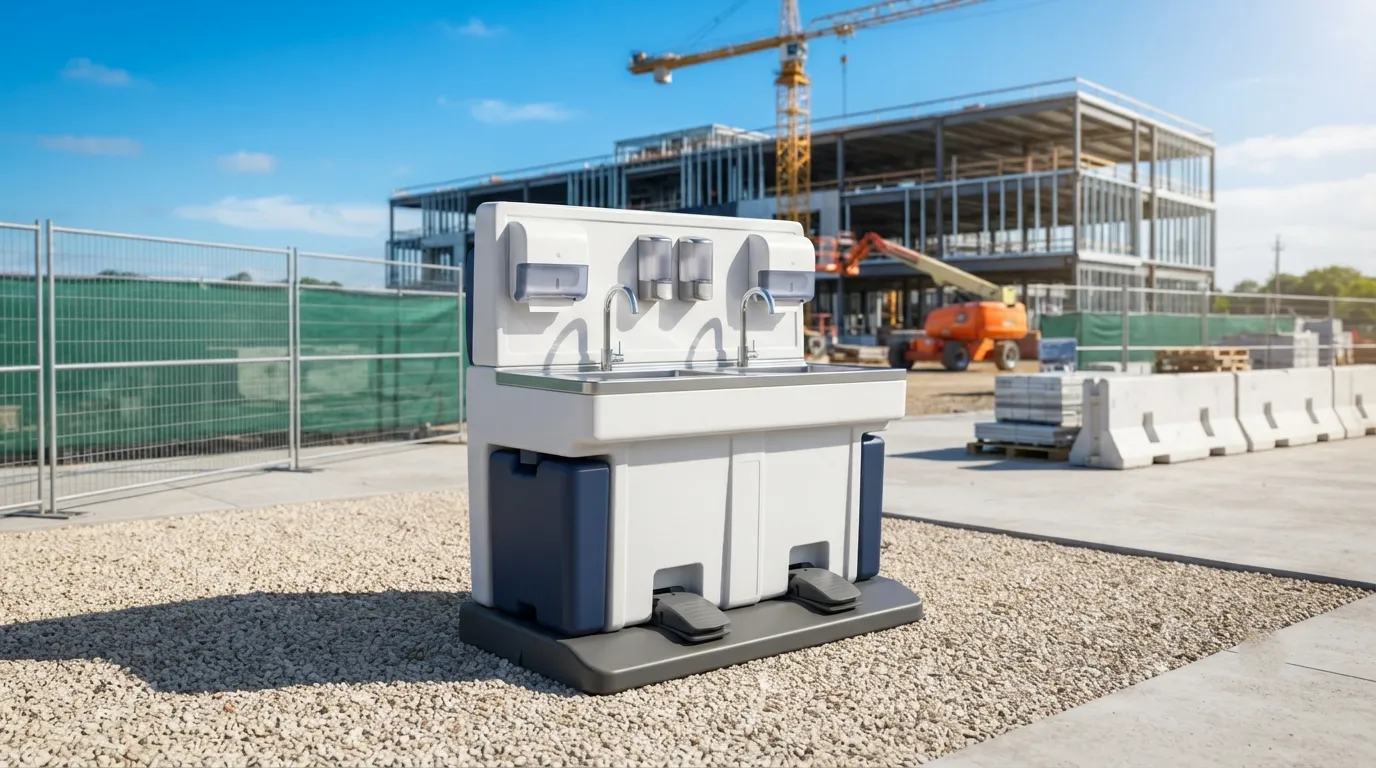
Water counts too. OSHA 1926.51(a)(1) requires an adequate supply of potable water at any place of employment, and that pairs with a handwashing station rental or a portable sink rental at each toilet location. Soap and towels are not optional extras. 29 CFR 1910.141(d)(2) is written for general industry, but the standard it sets, soap plus towels or a hand-drying device, not hand sanitizer alone, is the baseline we build every station to. If your operation also handles spraying, see the handwashing requirements after chemical application below.
Packing sheds and equipment yards near Goodyear often run mixed crews: field hands, forklift operators, seasonal packers. We size the unit count off your peak headcount, not your average day, because the ratio in 1928.110 does not flex for a slow Tuesday.
Why does spraying change the handwashing requirement?
Any crew applying pesticides or herbicides falls under a different rule than routine field sanitation. OSHA 1926.51(f)(1) requires washing facilities specifically where employees apply paints, coatings, herbicides or insecticides, or work with other harmful contaminants. That is not the general handwashing mandate; it is triggered by the chemical exposure itself, so a spray crew needs a wash station at the mixing and loading site even if the rest of the farm is already covered under 1928.110.
In practice we place a dedicated portable sink rental or handwash unit at the chemical staging area, separate from the crew's main toilet cluster, and service it on the same route. If your site also needs sanitizer stations for general foot traffic, a hand sanitizer station rental is a supplement, not a substitute. It doesn't satisfy 29 CFR 1910.141(d)(2), which calls for soap and towels or a drying device.
Farms that run their own repair bays or fuel storage sometimes need broader site setup. We handle that through construction site services, including temporary fencing around chemical storage and light tower rental for early or late shifts during harvest.
How much does a rental cost for a farm crew in Goodyear?
Pricing depends on unit count, how far units travel between fields, and how long the season runs. A standard unit runs in the same range whether it's parked at a Goodyear packing yard or out past Avondale, 2.6 miles northeast, but delivery adds up faster when units are spread across a large parcel instead of clustered at one gate.
| unit | day | week | month |
|---|---|---|---|
| standard | $100 - $350 | $130 - $500 | $125 - $325 |
| ada | $200 - $400 | $240 - $400 | -- |
| handwash station | request quote | request quote | request quote |
Seasonal contracts usually land on the monthly rate once harvest runs past a few weeks. For a full breakdown by duration, see porta potty rental cost and monthly porta potty rental. If you're comparing a short weekend crew push against a season-long lease, porta potty rental per day covers the short end.
Farms with a permanent office trailer or seasonal housing sometimes add a septic pumping service visit or a holding tank rental rather than tie into municipal sewer. A typical 1,000 gallon residential-style tank gets pumped every 3 to 5 years depending on tank size and household size; a farm bunkhouse with heavier use should be checked more often. Grease from a farm kitchen or processing shed gets pumped once fats, oils and solids reach 25 percent of the liquid depth, which is when a grease trap pumping call is worth making.
How many toilets does a 20-person crew need under ag rules?
One facility covers up to 20 hand-labor employees under OSHA 1928.110, with water and handwashing at the same location. Above that headcount, add units in the same ratio. See OSHA portable toilet requirements or use our how many porta potties do I need guide to size a mixed crew.
Do we need an ADA unit for farm workers?
If any worker or visitor needs an accessible unit, ADA Standards section 213.2 requires at least one accessible unit in any cluster of single-user toilets, even a small one. Details are on ADA accessible porta potty and ADA restroom requirements.
Can units be moved as harvest progresses?
Yes. Standard units are light enough to reposition by flatbed as crews shift fields. Schedule moves in advance so service day lines up with the new location; ask about routing when you request a quote.
What about a wash station for pesticide crews only?
Set a separate handwash unit at the mixing and loading area under OSHA 1926.51(f)(1), apart from general field toilets. This applies specifically to herbicide, insecticide, paint or coating work, not routine field sanitation.
Do you service farms outside Goodyear?
Yes. We run routes out to Avondale, 2.6 miles northeast, and can quote farms further out on request. Check service areas or call contact for a route check.
Next step
Get a delivery date
Tell us the address, the dates and the headcount. We size the order and confirm the route.